
The Project
ECHORD (European Clearing House for Open Robotics Development) is a new EU-funded project aiming to strengthen the cooperation between scientific research and industry in robotics. ECHORD is coordinated by Professor Knoll, Technical University of Munich. The project's international orientation and its positioning in the existing robotics landscape are emphasized by the participation of the University of Naples Federico II (Prof. Siciliano) and the University of Coimbra in Portugal (Prof. Pires). Europe has a very strong robot industry and there is significant research potential as well as technological knowledge. There has been a long history of outstanding research and development in both robot manufacturers and research institutes. However, finding common ground between manufacturers and the research community, especially when it comes to defining the future direction of robotics research, has proven difficult in the past. This is one of the recurring themes on both sides, and a new level of cooperation is long overdue. Thus, ECHORD will act as a "clearing house" to streamline successful know-how transfers. It is truly open to those entrepreneurial research institutes able to carry out challenging robotics development in cooperation with manufacturers which are interested in focusing on research and technology development, and it will ultimately increase European competitiveness in robotics.
The Scenarios
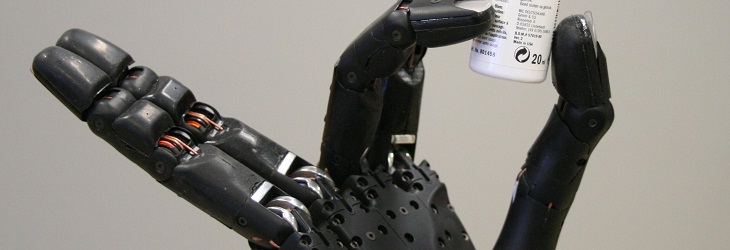
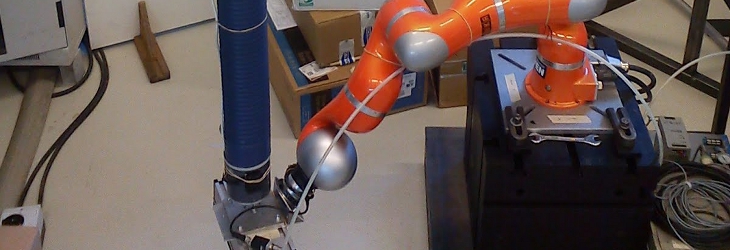
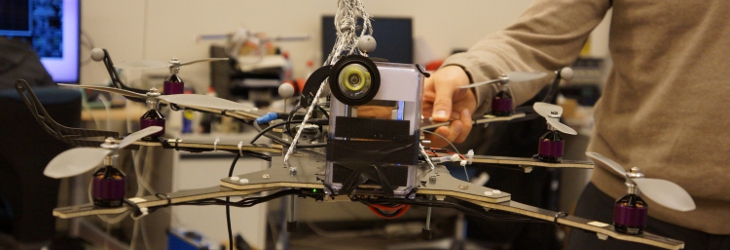
The range of research topics and subjects in the field of robotics is virtually unlimited. Thus, ECHORD has defined a clear thematic orientation which is reflected in selected scenarios. Three scenarios have been identified, which are both scientifically challenging and commercially relevant. They consist of challenges, which robotics experts can easily understand and use as a basis for their own research. The scenarios, which build on each other, are: "human-robot co-worker", "hyper-flexible manufacturing cells", and the "cognitive factory". Within these scenarios, different research foci have been identified. The research foci are reference points for the expected scientific progress of proposals for experiments. They combine mechanical design, controller technology developed by manufacturers, with the research community's expertise in sensing, cognition, and behaviour control. The research foci are "human-robot interfacing & safety", "robot hands & complex manipulation", "mobile manipulators & cooperation" and "networked robots".
The Experiments
It is the objective of ECHORD to take an industrial perspective and provide incentives for both sides. It is also our goal to systematically increase the number of successful cooperations between researchers and industry. Extensive discussions have revealed that it is appealing to carry out joint projects solving concrete problems, particularly if processes are simple and quick; these joint projects are called experiments. This will include those manufacturers and research institutions/organisations who have not had the opportunities to work together, and will enable partners with well-established cooperations to invest more. Within the framework of the ECHORD project, institutes and research organizations will have the chance to perform experiments using the latest industry-related hardware. Three rounds of open calls for experiments will be launched over the course of the project duration of 3.5 years. All European manufacturers and research groups are eligible to submit proposals. It is the intention of the project to keep the entry hurdles for potential applicants as low as possible and to attain quantifiable results as quickly as possible.
Broadening the network
ECHORD’s experiment kick-off meeting and workshops at the European Robotics Forum in Västerås, Sweden were a huge success!
Click here to find out more.
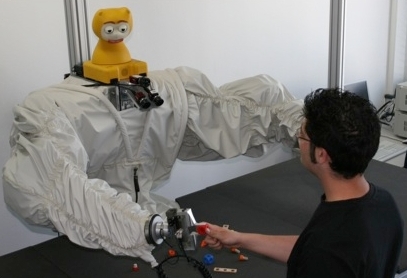
Lab Tour
Seneca once said: "Travel and change of place impart new vigor to the mind."
That is why ECHORD will sponsor two international lab tours to broaden our perspective on the state of the art of robotics and to give a dozen experts the chance to visit international labs in Asia and America. Are you interested in joining the tour?
NEWS!!! The dates for the lab tours have been changed.
Click here to find out more.
Contact
ECHORD Service Center
Technische Universität München
Department of Informatics VI
Robotics and Embedded Systems
Boltzmannstr. 3
85748 Garching Germany
Tel: +49 89 289 18136
Fax: +49 89 289 18107
Email: echord@in.tum.de Follow us on Twitter